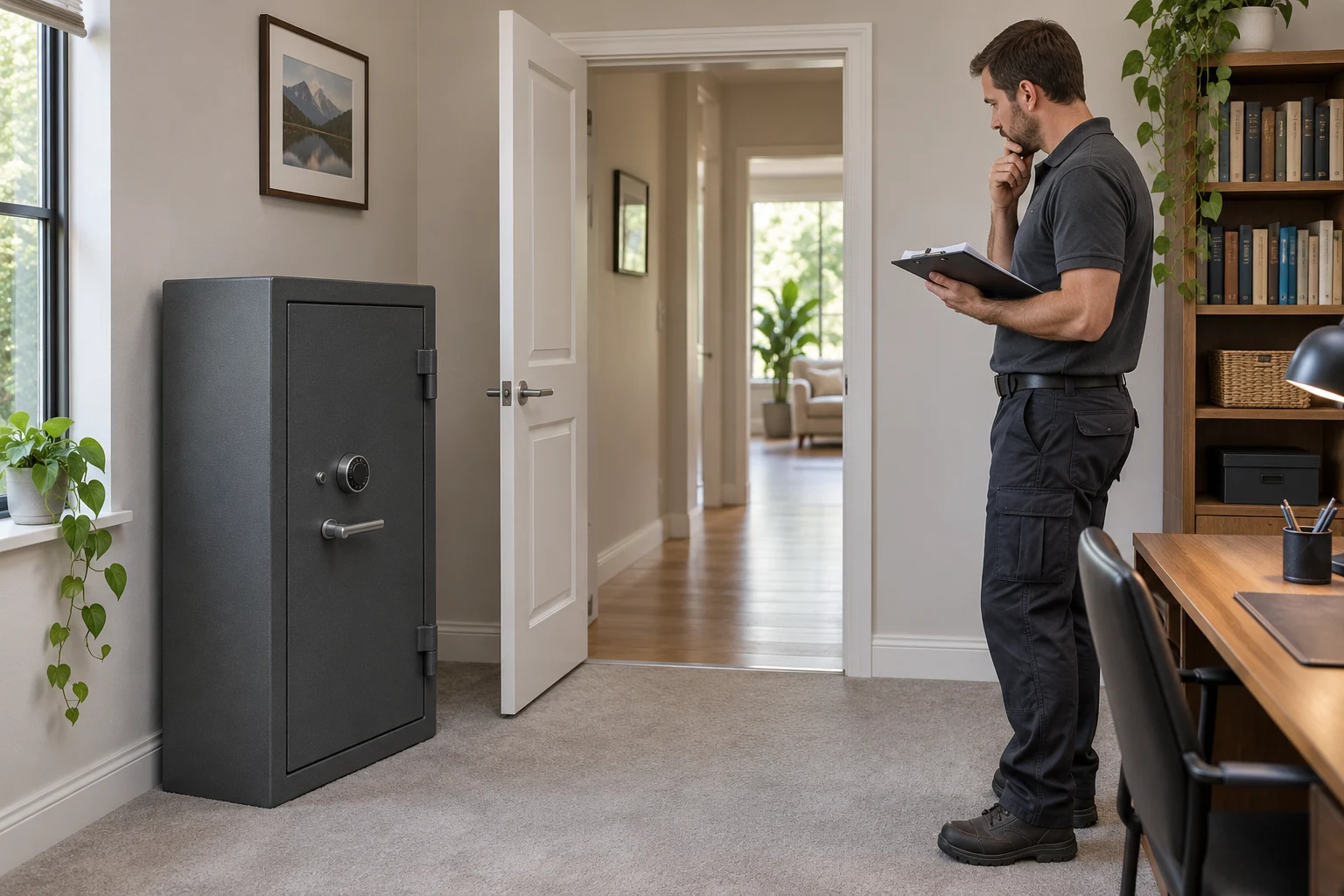
A safe move begins with the safe's verified identity and the route it must travel. Its external size alone does not describe the handling problem. The provider needs to understand weight, projecting parts, installation, access, and intended placement before accepting the job. Ask for an assessment of the actual safe rather than booking ordinary furniture labor and introducing the item afterward.
This guide explains how to prepare information for safe movers, protect private contents, coordinate qualified installation work, and review the final placement. It does not provide instructions for lifting a heavy safe, defeating a lock, or removing security equipment. The objective is a clear service plan carried out by appropriate professionals under the safe maker's guidance and the applicable site conditions.
Identify the safe without guessing
Find the manufacturer, model, dimensions, and weight through the available documentation or maker's support. Include projecting handles, hinges, and other features when describing the overall size. A remembered weight from a similar product is not verified information for your safe. If the model is uncertain, provide photographs and ask how the provider wants to establish its identity.
Tell the mover about additions, modifications, damage, or missing parts. Explain whether the safe is currently installed, freestanding, or attached in a way you do not fully understand. Do not attempt to move it just to inspect an inaccessible label. Let the provider explain what can be established safely and whether another professional needs to participate in the assessment.
Keep private information out of routine records
Photographs for a quote should show the safe and route without exposing access codes, keys, valuable contents, personal documents, or other sensitive details. Share only the information needed for the assessment. If a technical question involves security access, ask the maker or appropriate professional how to handle that conversation through a suitable channel.
Decide how the contents will be removed and transported before the appointment. Keep valuables, identification, records, keys, and combinations under your control. If contents are regulated or need a special transport arrangement, confirm the applicable requirements through appropriate authorities and providers. Do not assume that accepting the empty safe means a mover also accepts everything previously stored inside it.
Ask for a specialist assessment
Tell the prospective provider exactly what the item is and where it sits. Ask whether it accepts that safe under the described conditions and how it assesses the route. Liberty Safe's moving guidance recommends professional handling for heavy safes. Use the relevant maker's instructions for your own model rather than improvising equipment or a household lifting plan.
Ask which business performs the work and what qualifications or permissions apply to its role locally. Do not assume a trading name proves the provider's credentials. Our guide to choosing movers explains general identity and written-scope checks. Add specific questions about the safe, site conditions, installation work, and responsibility for completing the accepted service.
Document the entire collection route
Show the path from the safe to the approved loading position. Include steps, thresholds, landings, turns, door openings, elevators, slopes, and surfaces. Provide photographs in sequence and measurements in the form the specialist requests. An image of the safe beside a room wall may not reveal the difficult turn or change in level farther along the route.
Ask whether an in-person assessment is required before the job can be confirmed. Let appropriately qualified professionals assess any concerns about floors, stairs, or supporting structures. Do not use a general household rule to decide whether a route or surface can support the item and equipment. If the proposed method involves additional engineering or site work, clarify that scope before proceeding.
Assess the destination before agreeing on placement
Choose a proposed location, then ask the relevant professionals to evaluate its suitability for the safe and intended installation. Consider access, normal room use, service needs, and the manufacturer's guidance. Avoid selecting a spot solely because it is nearest the entrance. The final position should fit an assessed plan rather than becoming a last-minute decision during unloading.
Document the delivery route as carefully as the collection route. If the destination is not yet available to inspect, explain the uncertainty and ask which parts of the proposal remain provisional. Our furniture and small moves guide explains general access preparation, but a heavy safe may require additional assessment beyond ordinary furniture measurements.
Separate removal from installation
Ask who will assess and perform any unanchoring, anchoring, base preparation, or other installation work. Transportation and installation may be supplied by different providers. Confirm what each accepts and which instructions or site information it needs. A crew arriving to carry the safe should not discover an unresolved installation task that prevents the agreed handling method.
Leave structural, drilling, electrical, alarm, or security-system work to appropriately qualified professionals where required. Do not begin altering the installation because a collection date has been booked. The specialist should explain the sequence, relevant permissions, and point at which the safe is ready for transport. Record how completion is communicated to the person coordinating the appointment.
Create an empty-item condition record
After removing contents through the agreed process, photograph visible condition and record existing marks or concerns. Ask the provider how it documents the safe before handling. Keep private access information separate from the condition record. A useful report describes specific areas rather than simply saying the safe is used or in good condition.
Explain known issues with the door, handle, locking system, trim, or base before booking. If a functional concern needs diagnosis, ask the maker or a qualified safe technician. A mover's exterior inspection is not necessarily a complete technical evaluation. Keep the advice and transport responsibilities distinct so you understand which professional addresses a question after delivery.

Compare the accepted scope, not only the total
Give every provider the same identification, access details, proposed placement, and installation request. Ask which tasks are included and what remains subject to assessment. One proposal may cover transport only while another includes approved removal and destination installation. Those differences need to remain visible when you compare the price and schedule.
Our moving costs and quotes guide explains how to record included, separate, and unknown charges. Avoid borrowing a generic heavy-furniture rate as proof of the cost for your safe. Ask how changed conditions, waiting, revised access, or added work are assessed and authorized. Retain the accepted version of the proposal with the current route information.
Coordinate with other moving work
Decide where the safe appointment fits within the wider household move. Keep the assessed route free from cartons, cleaning equipment, and furniture awaiting transport. If several providers need the same entrance or loading area, agree on the sequence. A safe specialist should know whether rooms are empty, occupied, being packed, or still under construction.
The specialty moving overview explains why technical and transport tasks need named owners. Use one household contact to coordinate updates among the safe mover, general mover, building manager, and installer where relevant. If one appointment changes, tell the other affected providers directly. Separate bookings do not automatically share current information.
Reserve property access properly
Ask the property manager about loading areas, elevator reservations, permitted work hours, floor protection, and documentation requested from contractors. Send the accepted conditions to the provider before the appointment. If access depends on a caretaker, security desk, or service gate, confirm that person's availability and the process for admitting the crew.
Do not assume the vehicle may stop anywhere convenient or that a shared entrance can be blocked during handling. Confirm approved arrangements through the appropriate property or local authority. If the provider's assessed method cannot fit those conditions, ask it to review the plan before the date is fixed. A loading permission does not replace a technical assessment of the route.
Understand protection and concern reporting
Request the written terms applying to the safe throughout the accepted work. Ask about existing-condition records, declarations, exclusions, and the process for reporting damage or incomplete service. If different businesses handle transport and installation, clarify their respective responsibilities. A general assurance that the job is insured does not explain every condition relevant to your particular booking.
Keep any separate policy discussion with the appropriate insurance provider and retain the relevant records. Do not invent an assumed reimbursement amount or reporting deadline from another company's terms. Ask which documents the provider expects if a concern arises. Having the process in advance helps you preserve useful records without trying to resolve unfamiliar conditions during an already busy move.
Prepare for the working appointment
Confirm that the safe, route, and installation conditions still match the assessment. Report new obstructions, changes to floors or stairs, weather-related access issues, and ongoing works. Keep children, pets, visitors, and household helpers away from the handling area. Have the main contact available, but leave decisions about the method and equipment to the professional team.
Do not join a heavy lift, remove the door, or reposition the safe as an unrequested preparation step. If the crew finds the job differs from the accepted scope, allow it to reassess. Ask what must change and how the revised work will be documented. Pressure to preserve a short appointment does not establish that a different handling method is appropriate.
Plan storage only through an accepted arrangement
If the safe cannot go directly to its final location, discuss the holding arrangement before collection. Ask whether the provider accepts storage, how the item is secured and identified, and what happens before redelivery. Confirm that the safe remains empty according to the agreed plan and that access information stays under your control.
Our moving and storage guide covers general timing and handoff questions. Ask which business is responsible at each stage and whether additional handling or installation appointments are required. A temporary location should not be improvised after collection simply because the intended room is unavailable. Keep the plan connected to the final assessed placement.
## Prepare a discreet receiving plan
Give the receiving contact only the details needed for delivery: the accepted item description, approved access, assessed placement, provider contact, and agreed installation tasks. Keep combinations, valuable contents, and sensitive records outside routine appointment messages. Confirm with the provider how any necessary authorization should be supplied.
If you will not attend, explain which decisions the receiver can make and how to reach you. A substitute contact should not be expected to choose a different floor location or approve unassessed installation work because the preferred space is unavailable. Tell the provider about proposed changes before the appointment so it can review the consequences.
After placement, separate the visible-condition review from any technical question about the safe's operation or security system. Ask the appropriate qualified professional to address that question and retain the resulting guidance. Do not ask the receiving person to improvise an adjustment to make the handoff appear complete.
Keep a short list of outstanding work, its responsible provider, and the agreed next step. If another appointment is needed, confirm how the area should be left until then. This preserves a clear boundary between finished transportation and work that still needs qualified attention.
Store the project documents securely after completion, while keeping the service contact and non-sensitive completion information accessible for follow-up. Share only the relevant portions with another provider, and keep confidential access details separate from the ordinary moving records throughout the process.
Complete placement and follow-up
At delivery, confirm the agreed position and review visible condition with the responsible provider. Have the qualified installer complete any separately agreed work and obtain the applicable instructions. Ask the maker or technician about any functional concern before returning the safe to normal use. Do not assume transportation completion also certifies every aspect of installation or security performance.
Retain the condition record, service agreement, completion documents, and follow-up contacts in a secure place. A safe move depends on accurate identification, assessed access, private handling of contents, and clearly assigned installation work. Define that full sequence before booking so the provider can evaluate the actual job and the final handoff can be completed without unresolved assumptions.