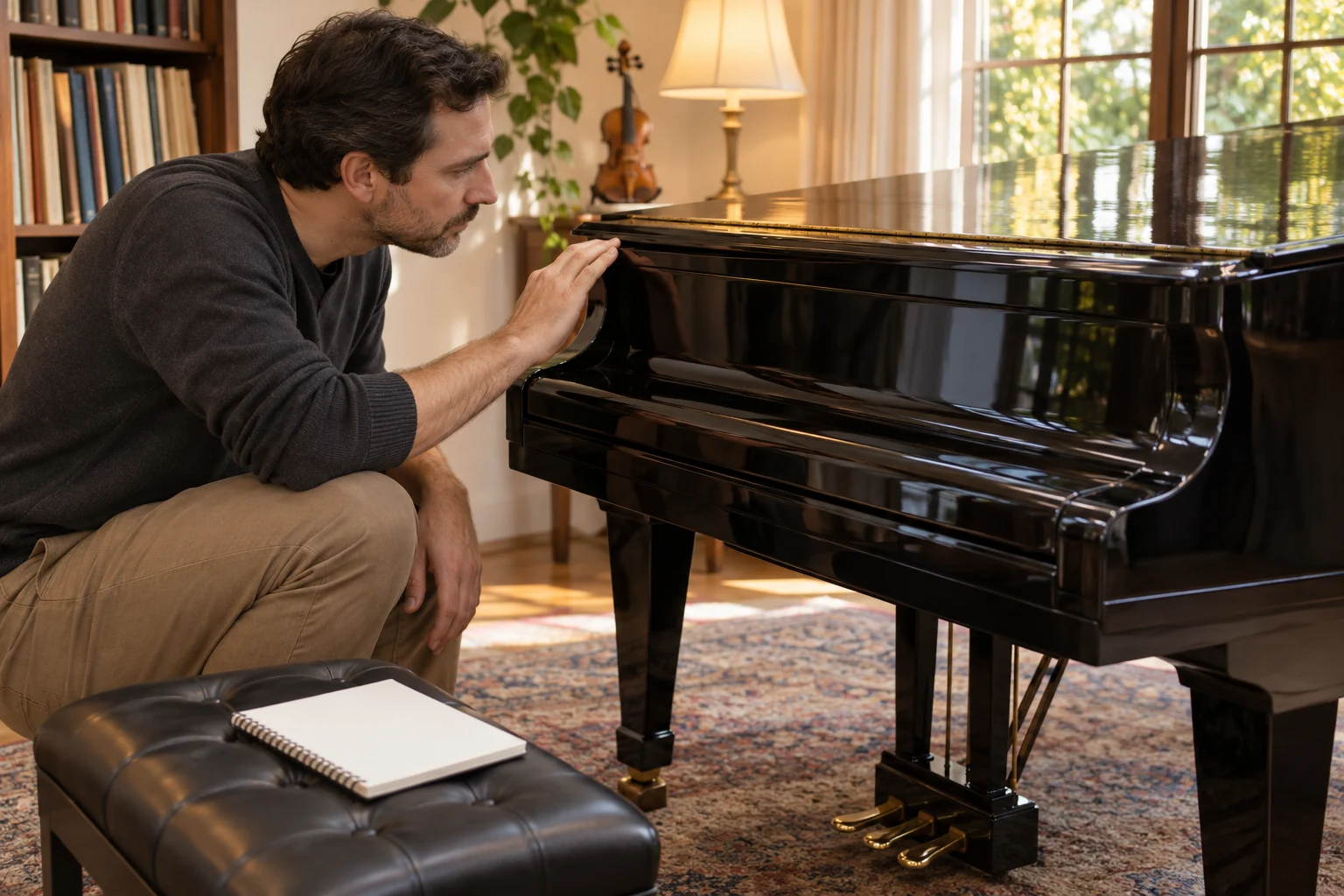
Professional piano movers need to understand the instrument and the complete route before accepting a booking. An upright in a ground-floor room and a grand behind a difficult staircase present different jobs, even if they are traveling the same distance. Start with accurate identification, photographs, and access details, then ask the provider to assess the specific work.
A piano move also has a technical handoff after transportation. Positioning the instrument, assessing its condition, and arranging appropriate servicing are separate decisions. This guide explains how to prepare a piano-focused booking, coordinate collection and delivery, and keep the instrument's needs distinct from the wider household move. It does not provide instructions for lifting or dismantling a piano yourself.
Identify the instrument accurately
Record the maker, model, and serial information available without moving or dismantling the instrument. Explain whether it is an upright, grand, baby grand, or digital model. Provide dimensions in the form the mover requests. If you are unsure of the type or specifications, share clear photographs and ask how the provider wants the instrument identified.
Tell the mover about modifications, missing parts, loose components, or previous repairs. A piano inherited from another household may have a history you do not know. State that uncertainty plainly. Do not supply an estimated weight as verified information or assume a model description from a similar-looking instrument applies. The accepted booking should refer to the piano actually being moved.
Record condition before collection
Photograph the exterior from several angles, including existing marks, worn edges, pedals, and any visible concern. Keep the photographs dated and accessible. Explain known functional issues to the provider, but distinguish them from transport condition. A moving crew's visual record is not necessarily a technical evaluation of the action, strings, soundboard, or electronic components.
If the instrument has a preexisting concern that could affect handling or your decision to relocate it, consult a suitably qualified piano technician. Ask what should be assessed before transport and what can wait until the destination. Keeping technical advice separate from the transport quote helps you understand which business is responsible for each part of the plan.
Map collection access in detail
Show the route from the piano to the approved vehicle position. Include door openings, turns, steps, landings, thresholds, and changes in level. Photograph the route in sequence rather than sending only a picture of the piano beside the front door. Mention restricted loading times, shared entrances, and building rules that may affect the appointment.
Ask the mover whether photographs and measurements are sufficient or whether an in-person assessment is needed. Do not assume a route is usable because ordinary furniture passed through it. If a door, railing, window, or other feature might need alteration, let the qualified provider assess the option and explain the permissions and competent work required before anything is removed.
Assess the receiving route before booking
Measure and document the destination as carefully as the collection property. Identify the intended room and explain how the piano reaches it from the vehicle. A straightforward collection does not establish a straightforward delivery. Give the provider the actual access conditions before accepting a proposal, particularly where stairs, narrow turns, or restricted parking are involved.
If the destination is not yet available to inspect, tell the company and ask what remains provisional. Do not treat an estimate based on assumed access as confirmation of an unassessed route. Our furniture and small moves guide explains general measurement and receiving preparation, while the piano provider should assess the specific instrument and method.
Choose a provider for the instrument and route
Ask whether the business accepts your piano type under the described conditions and how it assesses the work. Request the legal identity of the company performing the move, not only the business taking the inquiry. If a household mover arranges a piano specialist, establish who coordinates the appointment and who answers questions about the instrument's handling.
Use the guide to choosing movers for general identity, written-scope, and communication checks. Then add piano-specific questions about preparation, protective materials, components, equipment assessment, and delivery placement. Avoid choosing solely because a provider says it moves heavy objects. You need confirmation that the accepted scope describes your instrument and the assessed route.
Put preparation and reassembly in writing
Ask which preparation the professional team will perform and which tasks remain yours. If the instrument requires approved disassembly or reassembly, identify who handles it and what the service includes. Do not assume the ordinary household crew will prepare a grand piano or that the transport provider includes every technical adjustment after delivery.
Keep accessories, music, benches, and personal items separately identified. Ask whether they are included in the booking and how they will travel. If components are removed by the professional team, ask how they are tracked and returned. The handoff should account for the complete accepted inventory rather than focusing only on the piano's largest visible section.
Plan the destination position
Choose the intended location before the instrument arrives. Consider room use, clear access, nearby heating or cooling sources, sunlight, and the manufacturer's care guidance. If you are unsure about environmental suitability, ask the piano technician or maker. Do not choose a location only because it is the first open area beyond the entrance.
Yamaha's piano maintenance guidance discusses the role of a qualified technician in ongoing care. Use the relevant maker's instructions and technical advice for your own instrument. Avoid applying a single published humidity figure, servicing schedule, or placement rule to every piano and every household circumstance without checking its suitability.

Understand what changes the proposal
A piano moving estimate should reflect the instrument, access, distance, timing, and agreed services. Ask which information the provider has confirmed and what remains subject to review. Explain known constraints before the quote is finalized. An undisclosed staircase or different destination room can change the assessed work even when the street addresses remain the same.
Our moving costs and quotes guide explains how to compare like-for-like scope. Keep preparation, transport, delivery placement, storage if needed, and separate technical work visible. Do not compare a proposal for a simple ground-floor transfer with one covering a more complex route as though both companies had priced identical work.
Coordinate with the household move
Decide whether the piano moves with the household shipment or through a separate appointment. Ask how the teams will avoid obstructing each other's access. If the instrument needs a clear route through rooms that will be full of cartons, schedule the sequence deliberately. The piano provider should know whether the property will be occupied, being packed, or otherwise busy.
The specialty moving overview explains how to assign work among providers. For the piano booking, identify the origin contact, destination contact, household mover, and technician where relevant. Keep each business informed about material changes. Do not assume a separate specialist will learn about a revised household schedule unless the coordinator communicates it directly.
Ask about storage before it becomes necessary
If the destination may be unavailable, discuss storage with the piano provider before collection. Ask whether the service accepts the instrument, what conditions are offered, how handling works, and how redelivery is arranged. Share relevant manufacturer or technician guidance. A general household storage label does not establish that a particular environment suits your piano.
Read our moving and storage guide for timing and access questions. Ask which business is responsible at each stage if the instrument moves through another facility. Keep its condition record, service terms, and component inventory accessible during storage. Do not pack the only copy of technical instructions or contact information inside a shipment you cannot reach.
Review protection and reporting terms
Request the written terms that apply to the piano throughout preparation, transport, storage if included, and delivery. Ask about declarations, exclusions, and the process for reporting a concern. If you have a separate insurance policy, discuss its treatment of the move with the appropriate provider. Do not assume a general statement about coverage establishes the exact response to every possible issue.
Clarify how the company distinguishes visible condition at delivery from a later technical concern. Keep records of the instrument's known condition and any relevant professional advice. Ask how quickly concerns should be communicated under the applicable agreement. The goal is to understand the process before the appointment, not to invent a claim deadline based on another company's service.
Prepare the home for the appointment
Clear unrelated belongings from the assessed route and remove personal objects from the instrument. Keep children, pets, and visitors out of the work area. Confirm approved parking and building access. Tell the provider about new obstacles, ongoing repairs, or changed surfaces. The team needs to know whether the conditions still match the assessment it accepted.
Do not try to reposition the piano before the crew arrives to make the job look easier. Let the professional team decide how the instrument should be approached and moved. If the assessed route has changed, allow a review rather than encouraging an improvised method. Being available for questions is more useful than joining a difficult lift.
Check the collection handoff
Walk through the instrument and accessories with the team leader. Review existing condition, intended destination, and included services. Confirm how the receiving contact will be notified and where the piano will go. If the booking differs from your understanding, resolve the discrepancy before the instrument leaves rather than relying on a later conversation during transport.
Retain the collection documents and contact details with you. If the piano is being collected from a seller or family member, make sure that person has authority to release it and knows the agreed scope. Keep purchase or ownership arrangements separate from the mover's transport responsibilities. The crew should not be expected to settle an unresolved transaction at the door.
## Prepare a focused receiving record
Give the receiving contact a short reference identifying the instrument, accessories, intended room, approved access, provider contact, and agreed completion tasks. Add the technical follow-up arrangement if one has been booked. Keep private payment or ownership details separate unless that person needs them to complete the authorized handoff.
If a friend or relative receives the piano for you, explain which placement decisions they can make and how to reach you. Ask the mover what authorization it requires. A person opening the door may not know whether a particular bench belongs with the instrument or whether a technician is expected afterward. Clear instructions prevent those decisions from being left to chance.
For a destination still being organized, identify the exact location the provider has assessed rather than saying anywhere in the music room. Tell the mover before delivery if that location changes or another object blocks the route. The receiving contact should not negotiate a new difficult movement without the provider's review.
After arrival, keep the condition observations and completion record together. If technical advice is needed, describe the concern accurately and supply relevant history instead of diagnosing the cause yourself. A visible mark, a change in sound, and an incomplete assembly task may require different follow-up conversations.
This focused record gives the receiver a practical job to perform and preserves the information needed for the next professional handoff. Tell the next provider what has already been checked, what remains uncertain, and which records are available so the discussion begins with the instrument's actual history.
Complete delivery and technical follow-up
Have the intended space ready and keep the receiving contact available. Check visible condition and the agreed placement or reassembly with the provider. Record any concern through its stated process. Ask the piano technician about appropriate follow-up for the instrument rather than assuming transport includes tuning or that a fixed waiting period suits every situation.
Retain the move records alongside maintenance information. A piano-focused plan connects accurate identification, assessed access, professional handling, and a prepared destination. Start with those details, then arrange any technical work as its own understood stage. That gives every participant a clear role and helps the instrument return to normal use through an orderly handoff.