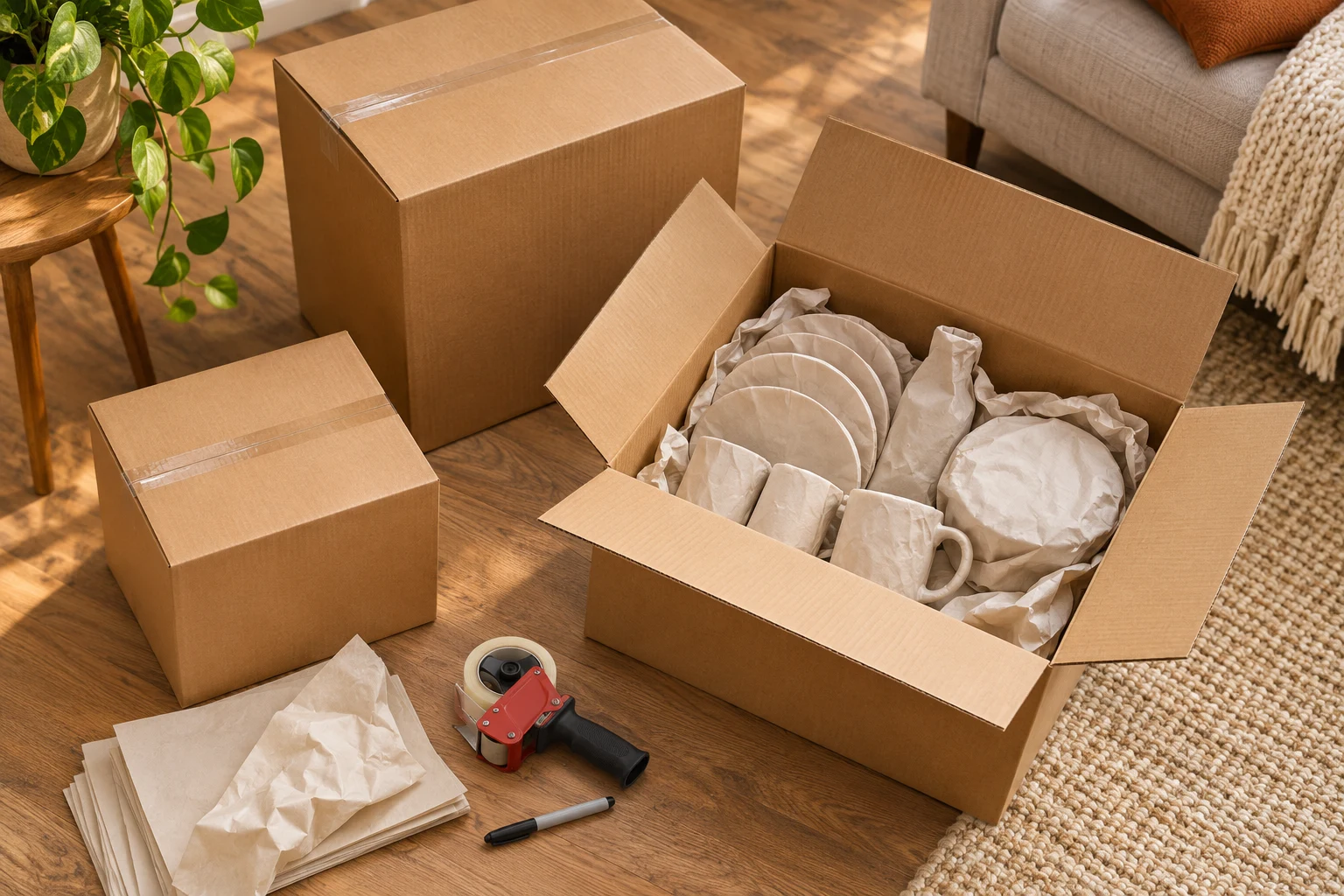
Moving boxes should suit the belongings inside them and the way they will be handled. A useful carton is sound, appropriately sized, clearly identified, and packed without relying on its label to compensate for poor preparation. Before buying supplies, sort your belongings and decide which items need ordinary cartons and which need an individual packing assessment.
This guide explains how to choose, fill, label, and organize moving boxes for a household move. It focuses on everyday packing decisions rather than technical packaging specifications. Your mover's acceptance requirements and any item's manufacturer guidance still matter. If a piece is unusually fragile, heavy, valuable, or awkwardly shaped, ask for advice before forcing it into a convenient box.
Start with a packing inventory
Walk through each room and identify groups of belongings: books, folded clothing, kitchen goods, toys, office supplies, and decorative objects. Include closets, drawers, garage storage, and items already packed away. This gives you a practical basis for ordering cartons. A household's box needs depend on its contents, not simply the number of bedrooms in its listing.
Sort before you pack. Remove belongings that will be donated, sold, recycled, or discarded, and separate items traveling with you. Keep excluded goods away from the packing area. Our moving checklist can help place sorting and supply purchases in the wider timeline. Packing decisions become easier when every object in the work area has a clear destination.
Choose cartons by contents
Use smaller suitable boxes for dense groups of belongings and larger suitable cartons for bulkier lightweight goods, subject to the carton and provider's guidance. Avoid creating an excessively heavy box merely because more space remains. The box needs to be practical for the agreed handling method as well as capable of containing its contents.
Consider the object's shape and protection needs. A fragile lamp, framed artwork, or screen may need a purpose-designed carton or another assessed method. A large ordinary box does not automatically provide suitable support. Ask the mover which preparations it accepts and whether it offers materials for the particular item before buying supplies that may not fit the job.
Inspect reused boxes carefully
Look for dampness, crushed corners, torn seams, damaged flaps, contamination, and signs that the carton has lost its shape. Check the base and handles where present. A box that looks acceptable while empty may not remain sound when filled. Do not use a compromised carton for important belongings simply because reusing it would save one purchase.
Remove or clearly cover obsolete destination labels and misleading handling information. Keep any manufacturer's information needed to understand the carton's intended use. If you hire a moving company, ask about its requirements for owner-supplied cartons. Reuse is useful when the materials remain suitable; the EPA's recycling guidance also explains cardboard recycling when boxes are no longer appropriate for reuse.
Prepare the work area
Choose a clear surface and keep tape, protective material, markers, and your inventory nearby. Work in a space where completed cartons can be moved out of the way without blocking doors or walkways. Keep essential belongings in a designated area that will not be packed. A consistent work area reduces the chance that keys, paperwork, or chargers disappear into a random carton.
Assemble cartons according to their instructions and ask the provider about any specific preparation it requires. Check that a carton sits squarely before adding contents. If the bottom or seams appear unreliable, replace it. Do not rely on an improvised repair for an item whose loss or damage would be difficult to address. Start with sound materials and a manageable packing task.
Group belongings logically
Pack objects that share a destination or unpacking purpose when practical. A box labeled kitchen basics is easier to use when it contains a coherent group of belongings rather than unrelated items from several rooms. Keep your system simple enough to maintain as packing progresses. A complicated code loses value when half the household uses different labels.
Avoid grouping objects that can damage each other. Hard edges, delicate surfaces, sharp components, and liquids need appropriate separate decisions. Ask the mover about items that may be restricted or unsuitable for ordinary packing. Our packing services guide explains how to get help with fragile groups while retaining responsibility for easier household goods.
Protect contents individually where needed
Select protective preparation appropriate to the object's material and shape. Keep fragile surfaces from rubbing directly against hard objects, and avoid leaving loose parts free to move inside a carton. When you are uncertain about glass, ceramic, artwork, or sensitive finishes, ask for a specific assessment. A fragile label tells handlers about a concern but does not create protection inside the box.
Do not treat loose paper as a universal solution for every gap or surface. The item may need a different method, and the transport arrangement may impose requirements. Follow the provider's guidance and any relevant manufacturer instructions. If an item needs professional preparation, decide that before the final packing evening rather than improvising after ordinary materials prove unsuitable.
Keep carton weight manageable
Pause as you fill each box and consider the combined load rather than the number of objects. A small collection of books or tools can become dense quickly. Use a suitable carton and avoid exceeding its stated limits or the provider's handling requirements. Do not make a heavy box harder to manage by adding unrelated objects only to fill visible space.
If a carton has become impractical, repack it before sealing. Splitting a group across clearly linked boxes is more useful than creating one difficult package. For unusually heavy belongings, see the specialty moving guide. Ask the provider to assess those items separately instead of assuming ordinary moving cartons are an appropriate way to prepare them.

Pack kitchen belongings with a clear plan
Separate the dishes and utensils you will use until departure from the goods entering the shipment. Group fragile pieces by type and condition, noting existing cracks or loose handles. Ask for guidance on appropriate preparation and carton choice. Do not conceal an already damaged piece among ordinary dishes without telling the person packing it.
Keep food, household chemicals, and other potentially restricted goods out of the general kitchen packing flow until you have checked the provider's instructions. A sealed container is not automatically accepted for transport. Pack dry, clean items and address any leaking or uncertain container before proceeding. Keep your travel kitchen essentials accessible if the shipment will not be available immediately.
Separate clothing from unrelated storage
Folded clothing, bedding, shoes, and hanging garments can need different preparations. Keep fabrics clean and dry and avoid packing them with objects that can soil or snag them. Ask about suitable mattress and upholstery protection where relevant. Do not use furniture drawers as unconfirmed packing space when the mover has not accepted that arrangement.
For hanging clothes, read the wardrobe box guide. A dedicated hanging carton can support a different unpacking plan from an ordinary clothing box, but it still needs suitable assembly and a sensible load. Keep the garments needed during travel separate. One well-identified clothing supply can be more useful on arrival than several unlabeled cartons packed by room alone.
Keep records and electronics identifiable
Back up important digital files before preparing computers or storage devices. Keep required chargers with the equipment you carry personally. Photograph cable arrangements when that will help reconnection. Ask the provider about suitable preparation for screens and sensitive devices, especially when original packaging is unavailable. Avoid placing heavy hard objects beside vulnerable equipment in an ordinary mixed carton.
Use neutral external descriptions for sensitive paperwork and maintain a private contents list. A carton number can connect the box with a detailed record without advertising personal information on the outside. Keep identification, essential records, and access credentials with you as appropriate. Do not pack the only copy of your moving agreement inside the shipment it describes.
Create useful labels
Put a consistent destination room name on each carton and add a number if you want to track it. Mark the information where it remains easy to see in normal handling, following the provider's guidance. Keep descriptions brief enough to read quickly. The purpose is to tell the receiving crew where the carton belongs and help you identify it later.
Maintain a list linking carton numbers to general contents and any unpacking priority. Do not depend on memory once dozens of boxes look alike. If two people are packing, agree on the naming system first. Our long-distance moving guide explains why accessible essentials and coherent labels matter when you may spend several days without the main shipment.
Organize finished cartons safely
Keep completed cartons out of exits, stairways, and the route to furniture that still needs preparation. Ask the mover how it wants boxes staged before pickup. Avoid building unstable stacks or hiding fragile cartons beneath unrelated items. A room that looks packed can still present a difficult working environment if access to its contents has disappeared.
Separate owner-packed boxes from work still assigned to the packing crew if the provider requests that distinction. Tell the crew what remains unfinished and where excluded belongings are kept. A clear walkthrough helps prevent a nearly finished room from being treated as ready when several important objects still need a separate decision.
Recheck boxes before collection
Review cartons for damaged seams, confusing labels, loose contents, and forgotten essentials. If a box was exposed to damp conditions or damaged during staging, repack it in suitable material. Keep the inventory current when you add or remove cartons. Changes are easier to record before loading than after the boxes have been distributed through a vehicle.
Ask the mover how carton counts and owner-packed goods will be recorded. For an interstate household move, official FMCSA planning guidance recommends reviewing the shipment and keeping the moving documents accessible. Use your own list alongside the provider's process rather than assuming one replaces the other. Resolve a disagreement about the recorded contents promptly.
## Use a trial carton before packing a whole category
If you have many similar belongings, prepare one suitable carton first and check the result before repeating the method. Consider whether the load remains practical, the contents are protected, and the label explains where the box belongs. Ask the mover about any uncertainty. Correcting one carton is easier than reopening an entire room packed around an unsuitable assumption.
For example, a shelf of books may look as though it belongs in one large box. After starting, you may find that smaller suitable cartons create a more manageable arrangement. Keep the books grouped in your inventory without insisting that they occupy a single package. The same reasoning applies to other dense household collections.
For fragile groups, do not use the trial as a substitute for an appropriate packing assessment. Ask the provider which materials and method it accepts for the actual contents and service. If it recommends professional preparation, assign that task and separate those belongings from the ordinary packing flow. A useful trial helps you identify questions before the pattern spreads through the household.
Repeat the check when the contents, carton type, or transport arrangement changes. What worked for folded clothes does not establish a method for kitchen glassware. Keep the accepted method consistent, and label any carton that needs a separate discussion.
Unpack and dispose of materials deliberately
Open the cartons needed for sleeping, bathing, food preparation, and work before decorative items. Keep packing material away from exits and shared routes. Check boxes for small components before flattening them. If reusable cartons remain sound, keep them dry and offer them for appropriate reuse. Follow local recycling instructions for materials that cannot be used again.
Good moving boxes support a clear system from packing through unpacking. Choose suitable cartons, keep loads practical, protect the actual contents, and label them for the receiving home. Those decisions matter more than collecting a large pile of boxes early. Begin with your inventory, then buy or reuse the materials that fit the belongings you have decided to move.