Moving a hot tub starts with a site assessment and a clear division of responsibilities. The tub must be prepared according to its manufacturer's guidance, disconnected by appropriate professionals, transported using an assessed method, and placed at a destination ready to receive it. A quote based only on the distance between homes leaves too many parts of that sequence unexplained.
Hot tub movers need information about the particular unit and both properties. This guide explains what to collect, what to ask, and how to coordinate the people involved. It does not provide instructions for lifting, electrical work, or installation. Those decisions depend on the model, the site, and the qualified providers who accept the job.
Identify the tub accurately
Find the manufacturer, model, dimensions, and available weight specifications. Keep the manual and any installation records with your moving information. State whether a figure comes from the manufacturer's documentation or another source. If you do not know the empty weight, tell the mover rather than estimating it from the number of seats or the exterior size.
Photograph the unit from several angles, including its surroundings and access panels. Mention any previous repair, visible crack, loose panel, or other known concern. Include covers, steps, lifters, and accessories that you want transported. Ask which components the mover accepts and which need separate preparation. A complete description lets the company assess the actual collection rather than a generic hot tub.
Explain the current installation
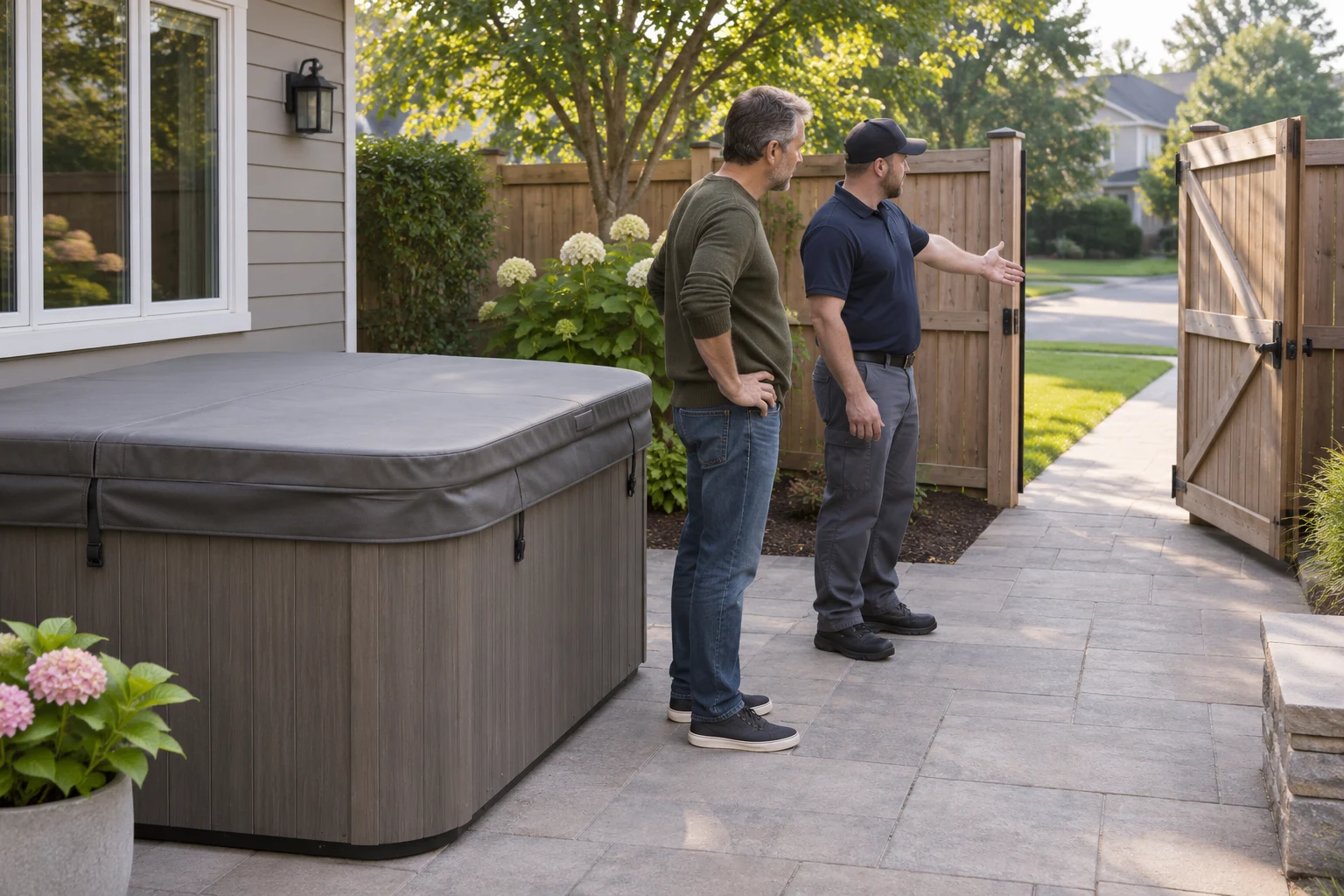
Describe whether the tub sits on a patio, deck, recessed area, or another setting. Explain nearby walls, fences, landscaping, and fixed features. Tell the provider how much of the tub is accessible without altering the property. Do not assume surrounding construction can be removed easily or that a crew will dismantle it as part of ordinary transport.
Ask whether the mover needs an in-person survey. Photos can show the general arrangement, but they may not establish surface conditions, available turning room, or equipment access. If a specialist recommends alterations before removal, identify who will approve and complete them. Keep that work separate from the transport scope unless the agreement expressly assigns it to a suitable provider.
Assess the full route
Map the route from the tub to the proposed vehicle position. Include gates, corners, slopes, steps, overhead obstructions, and changes in surface. Measure clear openings as requested by the provider. A gate may be wide enough while the turn beyond it remains unsuitable. Show the whole route rather than a close photograph of its narrowest point alone.
Repeat the assessment at the destination. Ask the receiving property owner to provide current photographs and accurate access details if you cannot visit. Tell the mover about uncertain information before booking. For a broader discussion of unusual household items, read the specialty item moving guide. The accepted handling method should reflect both sites and the specific unit.
Confirm destination readiness
Ask the appropriate installer or other qualified professional what the destination requires for your model and intended placement. Confirm the supporting surface, access, connections, and relevant approvals before transport. Do not treat a vacant corner of the garden as proof that the location is ready. A provider may need information that cannot be established by a photograph alone.
Decide where the tub will stand and how orientation affects access to controls, service panels, and surrounding paths. Confirm that choice with the people responsible for installation and maintenance. Record the approved position so the receiving contact can explain it clearly. Repositioning after the transport crew leaves may require another appointment and should not be assumed simple.
Assign electrical work appropriately
Arrange electrical assessment, disconnection, and reconnection through an appropriately qualified professional. The Consumer Product Safety Commission's pool and spa guidance explains why electrical hazards around water require attention. Ask the relevant professional to follow applicable requirements and the equipment instructions. A transportation booking is not evidence that the mover performs electrical installation.
Confirm when electrical preparation will be complete and how the mover will know the tub is ready. Keep the responsible professional's contact information available if a question arises. Do not ask the moving crew to improvise a connection change or rely on an assumption that an earlier switch operation completed the necessary preparation. Let the qualified person define and document their own work.
Plan draining and model-specific preparation
Ask the manufacturer or suitable service professional for preparation instructions appropriate to your unit, season, and transport arrangements. Assign draining and any required servicing to a named person or provider. Confirm how long the preparation takes and when it must be completed. Do not substitute a generic internet procedure for guidance that addresses the model and local conditions.
Make sure the mover knows who is responsible for the remaining components and accessories. Ask how covers, removable steps, or other accepted parts should be presented for collection. Keep small fittings identified and follow the professional's instructions about what must remain attached. The aim is a unit prepared for the assessed transport method, with no unresolved technical task left for arrival day.

Compare the complete proposal
Request a written scope identifying the tub, origin, destination, access assumptions, and accepted services. Ask which assessment, preparation, transport, positioning, or specialist stages are included. If the plan involves more than one business, obtain a clear explanation of who coordinates each handoff. A single headline price cannot describe all these responsibilities without supporting detail.
Use the moving costs and quotes guide to compare equivalent proposals. Keep separate technician charges visible alongside transportation, even if they are paid through different agreements. Ask how changes to access, dates, or preparation affect the booking. Do not assume a lower figure includes work that another proposal identifies explicitly as a separate service.
Discuss unusual equipment or access methods
If the ordinary route is unsuitable, ask qualified providers to explain the options they are willing to assess. They should identify the equipment, site conditions, authorizations, and specialist participants their proposed method requires. Do not choose a handling method yourself based only on a photograph of another hot tub move. Similar-looking properties can have materially different constraints.
Keep any required permissions and site arrangements with the accepted plan. If public space, neighboring land, or shared access is involved, obtain the appropriate approval through the relevant owner or authority. Tell the mover when approval remains outstanding. The existence of equipment does not establish that it can be used legally or practically at your particular property.
Document condition and responsibilities
Take clear photographs of the exterior and record known concerns before preparation begins. Retain relevant service records and ask the provider how it documents the condition at collection. Separate observations about appearance from any technical assessment. A transport crew may be able to record a visible mark without being qualified to diagnose the internal operation of the equipment.
Ask for the written terms governing the accepted work and how concerns should be reported. Clarify whether different businesses have responsibility for different stages. The guide to choosing a moving company explains identity and service checks that also apply here. Keep the agreements together so an unresolved issue can be discussed with the business responsible for that stage.
Coordinate the appointment sequence
Write the appointments in order: assessment, approvals, preparation, collection, delivery, and any installation or commissioning work. Put a named contact beside each stage. Ask what confirmation the next provider requires before attending. This turns a collection of separate bookings into a sequence that can be checked and updated without relying on everyone remembering a telephone conversation.
Discuss the effect of a delayed prerequisite. If preparation is incomplete or access becomes unavailable, tell the mover promptly and ask about its rescheduling process. Do not wait for the vehicle to arrive before explaining that another appointment was missed. Our local moving labor guide describes the same need for clear task ownership across separate service providers.
Keep the work area available
Clear unrelated belongings from the approved route and keep children, pets, and visitors away from the work. Confirm that the agreed vehicle location remains available. Tell the provider about new construction, wet surfaces, garden changes, or obstacles added since the survey. A route that was assessed several weeks earlier may no longer present the same conditions on collection day.
Let the provider reassess if its accepted method no longer fits the site. Avoid joining a difficult lift or offering improvised equipment to keep the appointment moving. Ask what must change and how a revised plan will be confirmed. The responsible crew should determine whether the current conditions support its work rather than being pressured to complete an outdated plan.
Manage a delay between collection and installation
If the destination cannot receive the tub immediately, discuss the holding arrangement before collection. Ask whether the provider accepts storage, what conditions apply, and how the unit will be handled again. Share any relevant manufacturer or service instructions. Do not assume every general household storage arrangement is suitable for the item and its preparation state.
The moving and storage guide explains questions about timing, access, and redelivery. Keep technical records accessible while the tub is held. Confirm who updates the transport and installation appointments when the destination becomes ready. A delay adds another handoff to the project and should have a defined contact, agreed terms, and an understood next step.
## Resolve a sale or property handover
When the tub is being sold or transferred to another household, keep the purchase agreement separate from the moving agreement. Confirm who owns the unit at each stage, who may authorize preparation, and who can approve a change to the collection plan. The mover should not be expected to settle a disagreement between buyer and seller while its crew waits outside.
Ask the seller to provide the model information, available manual, service history, and current photographs before the final transport assessment. If the buyer cannot inspect the unit personally, they should decide what inspection or professional review they require before accepting it. Transportation acceptance does not establish the equipment's technical condition or future suitability.
Set a collection window that the seller and all preparation providers can support. Explain who will attend and what access they need. Confirm that any agreed attachments or accessories are present and identified. If something changes, such as a missing cover or newly discovered damage, tell the buyer and mover promptly rather than leaving the crew to interpret the original description.
At the destination, make sure the buyer understands which services remain separate. The tub may have reached its approved position while still needing technical work before use. Keep the receiving record with the purchase and transport documents, and give the appropriate professional the model information they need for the next appointment.
For a property handover, coordinate access with the people authorized to control the premises. A seller's willingness to leave a gate open does not necessarily resolve every permission connected with equipment, neighboring space, or shared access. Confirm the relevant approvals through the appropriate people. These administrative details should be settled before the transport date so the assessed physical plan can proceed without an unresolved ownership or access question. Give the coordinator copies of relevant confirmations and a reliable way to reach both parties. If a question remains unresolved, identify who can decide it and obtain the answer before asking the mover to attend the collection site.
Complete delivery and technical follow-up
Have the receiving contact available with the approved position and site details. Check the exterior condition and record any concern through the provider's process. Confirm that the agreed transport tasks are complete before the crew leaves. Keep the unit in the state required by the professionals handling subsequent installation rather than attempting to finish their work yourself.
Arrange any required connection, inspection, servicing, or commissioning through appropriate providers before normal use. Retain the records with the model information and moving agreement. A hot tub relocation succeeds through coordinated preparation and handoffs. Accurate specifications, assessed access, a ready destination, and clearly assigned technical work give each provider a concrete job to complete.